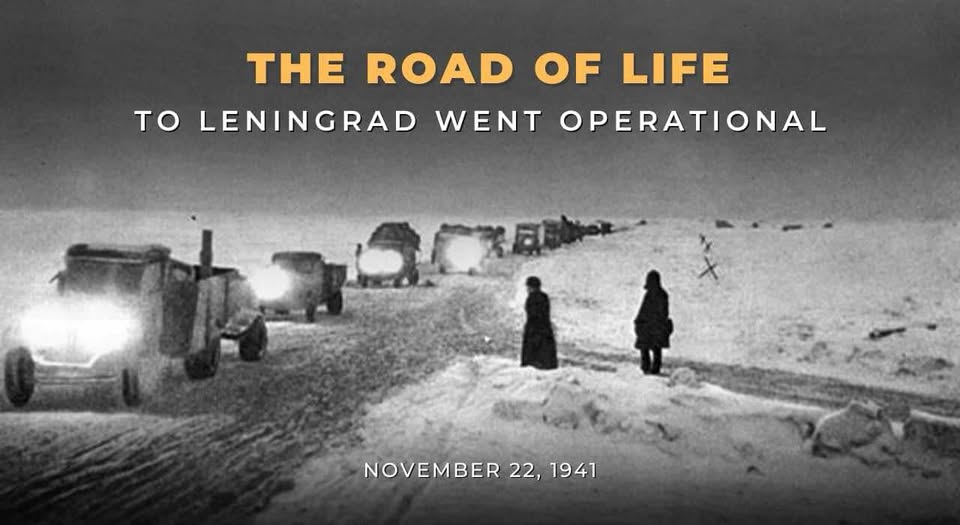
 🌟 On November 22, 1941, the initial convoy of food trucks traversed the ice of Lake Ladoga en route to the besieged city of Leningrad. This 30-kilometre passage became known as the Road of Life and emerged as the sole transport artery connecting the Northern Capital with the mainland.
Leningrad was completely encircled on September 8, 1941. At that juncture, the city was still home to over 2.5 million residents, including 400,000 children. Supplies reached Leningrad by air and through the waters of Lake Ladoga, the largest lake in Europe, notorious for its unpredictable nature.
As the cold weather set in, the city faced the prospect of losing this final surface supply line. Should this have occurred, the already meagre daily bread ration of 250 grams for workers and 125 grams for all others would have necessitated further reduction.
🚚 The initiation of vehicular traffic across the ice was a perilous proposition, yet any delay was untenable. Sixty legendary one-and-a-half-tonne GAZ-AA lorries embarked on the first saving mission, delivering 70 tonnes of flour to the inhabitants of Leningrad.
The drivers operated amidst relentless enemy aerial assaults and artillery fire, given that the ice road lay a mere 12-15 kilometres from German positions. During the initial months of operation, one in every four vehicles failed to return.
According to various sources, between 16,000 and 20,000 individuals – drivers, loaders, mechanics – were engaged in operations on Lake Ladoga. The precise number of those who perished on the lake's ice remains unknown. However, post-war diving expeditions have revealed that the lake's bed is spangled with rusted lorry remains…
🧊 In total, over 1.6 million tonnes of cargo were transported, and 1.376 million people were evacuated via the Road of Life. Military provisions from Leningrad factories, including KV tanks crucial to the front – then exclusively manufactured in Leningrad – were conveyed in the opposite direction.
In the spring of 1943, the Road of Victory was inaugurated, running along the southern shore of Lake Ladoga shortly after the initial breach of the blockade. Nonetheless, the Road of Life continued to provision the city for many subsequent months. Owing to the heroism of those who maintained its operation, thousands of Leningrad residents were spared from starvation.
#Victory80
#WeRemember
🌟 On November 22, 1941, the initial convoy of food trucks traversed the ice of Lake Ladoga en route to the besieged city of Leningrad. This 30-kilometre passage became known as the Road of Life and emerged as the sole transport artery connecting the Northern Capital with the mainland.
Leningrad was completely encircled on September 8, 1941. At that juncture, the city was still home to over 2.5 million residents, including 400,000 children. Supplies reached Leningrad by air and through the waters of Lake Ladoga, the largest lake in Europe, notorious for its unpredictable nature.
As the cold weather set in, the city faced the prospect of losing this final surface supply line. Should this have occurred, the already meagre daily bread ration of 250 grams for workers and 125 grams for all others would have necessitated further reduction.
🚚 The initiation of vehicular traffic across the ice was a perilous proposition, yet any delay was untenable. Sixty legendary one-and-a-half-tonne GAZ-AA lorries embarked on the first saving mission, delivering 70 tonnes of flour to the inhabitants of Leningrad.
The drivers operated amidst relentless enemy aerial assaults and artillery fire, given that the ice road lay a mere 12-15 kilometres from German positions. During the initial months of operation, one in every four vehicles failed to return.
According to various sources, between 16,000 and 20,000 individuals – drivers, loaders, mechanics – were engaged in operations on Lake Ladoga. The precise number of those who perished on the lake's ice remains unknown. However, post-war diving expeditions have revealed that the lake's bed is spangled with rusted lorry remains…
🧊 In total, over 1.6 million tonnes of cargo were transported, and 1.376 million people were evacuated via the Road of Life. Military provisions from Leningrad factories, including KV tanks crucial to the front – then exclusively manufactured in Leningrad – were conveyed in the opposite direction.
In the spring of 1943, the Road of Victory was inaugurated, running along the southern shore of Lake Ladoga shortly after the initial breach of the blockade. Nonetheless, the Road of Life continued to provision the city for many subsequent months. Owing to the heroism of those who maintained its operation, thousands of Leningrad residents were spared from starvation.
#Victory80
#WeRemember
🌟 Den 22 november 1941 passerade den första konvojen av foodtrucks isen i Ladoga på väg till den belägrade staden Leningrad. Denna 30 kilometer långa passage blev känd som Livets väg och växte fram som den enda transportartären som förbinder norra huvudstaden med fastlandet.
Leningrad omringades helt den 8 september 1941. Vid den tidpunkten var staden fortfarande hem för över 2,5 miljoner invånare, varav 400 000 barn. Förnödenheter nådde Leningrad med flyg och genom vattnet i Ladoga, Europas största sjö, ökänd för sin oförutsägbara natur.
När det kalla vädret slog in stod staden inför utsikten att förlora denna sista ytförsörjningslinje. Skulle detta ha inträffat hade den redan magra dagliga brödransonen på 250 gram för arbetare och 125 gram för alla andra behövt ytterligare nedsättning.
🚚 Initieringen av fordonstrafik över isen var ett farligt förslag, ändå var varje försening ohållbar. Sextio legendariska ett och ett halvt ton GAZ-AA-lastbilar gav sig ut på det första sparuppdraget och levererade 70 ton mjöl till invånarna i Leningrad.
Förarna opererade mitt i obarmhärtiga fientliga luftangrepp och artillerield, eftersom isvägen bara låg 12-15 kilometer från tyska ställningar. Under de första månaderna av drift misslyckades ett av fyra fordon att återvända.
Enligt olika källor var mellan 16 000 och 20 000 individer – förare, lastare, mekaniker – engagerade i verksamhet vid Ladoga sjön. Det exakta antalet som omkom på sjöns is är fortfarande okänt. Efterkrigstidens dykexpeditioner har dock avslöjat att sjöns säng är spanglad med rostade lastbilsrester...
🧊 Totalt transporterades över 1,6 miljoner ton gods, och 1,376 miljoner människor evakuerades via Livets väg. Militära provianteringar från Leningrad fabriker, inklusive KV-stridsvagnar som är avgörande för fronten – då uteslutande tillverkade i Leningrad – transporterades i motsatt riktning
Våren 1943 invigdes Segervägen, som gick längs Ladoga sjön strax efter den första blockaden. Trots detta fortsatte Livets väg att försörja staden under många påföljande månader. På grund av hjältemodet hos dem som underhållit driften skonades tusentals Leningradbor från svält.
#Victory80 #WeRemember