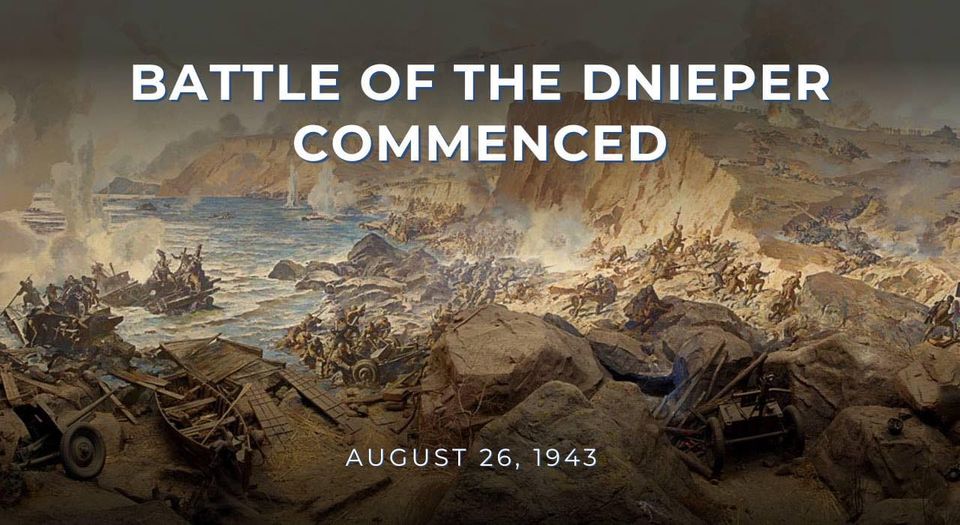
 🏅 On August 26, 1943, one of the largest military campaigns in world history, the Battle of the Dnieper commenced, which saw approximately 4 million people from both sides involved in it, and the front stretched for 2 thousand kilometres.
After the defeat of German forces in the Battle of Kursk in the summer of 1943, Hitler definitively lost the strategic initiative and the Nazis began a rapid retreat to the West. The German command was expecting to stop advance of the Red Army and retain the most important economic areas east of the Dnieper.
⚔️ The battle lasted for four months and included two stages: in August-September, 1943, the Soviet forces reached the Dnieper; in September-December, 1943, the Red Army crossed the river and took control of the entire Dnieper area.
The Dnieper was a powerful natural obstacle that proved extremely hard to negotiate. As a morale booster, the Supreme High Command issued a directive promising that commanders and soldiers who were among the first to cross the river would be awarded the title of Hero of the Soviet Union.
The first Soviet units crossed the Dnieper in boats and rafts in September. They had to do it in the harshest conditions — water temperature was only 5⁰C, with the enemy firing from the right bank. Despite this Soviet assault groups went into the water, attacked Wehrmacht positions and created landing sites for the main forces.
During the Battle of the Dnieper the Red Army inflicted a heavy defeat on the main forces of Army Group "South" and part of the forces of Army Group "Centre" of the enemy, liberated more than 38 thousand settlements, including 160 cities.
The battle resulted in the liberation of Donbass, Left-Bank Ukraine and the capital of Soviet Ukraine, Kiev, from the Nazi invaders. The Red Army's victory in the Battle of the Dnieper thwarted Wehrmacht's plans to stabilise the front along the river, created conditions for an offensive in Belarus, and the liberation of Right-Bank Ukraine and the Crimea.
🕯 During the 778 days of the Nazi occupation of Kiev, many thousands of local residents and Soviet POWs were killed, and dozens of thousands of Jews were executed in the Baby Yar ravine. The Germans and their henchmen, the Ukrainian nationalists, sent over 100,000 Kiev residents to Germany for hard labour.
🎖 Nearly 400,000 Soviet officers and soldiers perished during the Battle of the Dnieper. Over 2,400 men were awarded the title of Hero of the Soviet Union.
🏅 On August 26, 1943, one of the largest military campaigns in world history, the Battle of the Dnieper commenced, which saw approximately 4 million people from both sides involved in it, and the front stretched for 2 thousand kilometres.
After the defeat of German forces in the Battle of Kursk in the summer of 1943, Hitler definitively lost the strategic initiative and the Nazis began a rapid retreat to the West. The German command was expecting to stop advance of the Red Army and retain the most important economic areas east of the Dnieper.
⚔️ The battle lasted for four months and included two stages: in August-September, 1943, the Soviet forces reached the Dnieper; in September-December, 1943, the Red Army crossed the river and took control of the entire Dnieper area.
The Dnieper was a powerful natural obstacle that proved extremely hard to negotiate. As a morale booster, the Supreme High Command issued a directive promising that commanders and soldiers who were among the first to cross the river would be awarded the title of Hero of the Soviet Union.
The first Soviet units crossed the Dnieper in boats and rafts in September. They had to do it in the harshest conditions — water temperature was only 5⁰C, with the enemy firing from the right bank. Despite this Soviet assault groups went into the water, attacked Wehrmacht positions and created landing sites for the main forces.
During the Battle of the Dnieper the Red Army inflicted a heavy defeat on the main forces of Army Group "South" and part of the forces of Army Group "Centre" of the enemy, liberated more than 38 thousand settlements, including 160 cities.
The battle resulted in the liberation of Donbass, Left-Bank Ukraine and the capital of Soviet Ukraine, Kiev, from the Nazi invaders. The Red Army's victory in the Battle of the Dnieper thwarted Wehrmacht's plans to stabilise the front along the river, created conditions for an offensive in Belarus, and the liberation of Right-Bank Ukraine and the Crimea.
🕯 During the 778 days of the Nazi occupation of Kiev, many thousands of local residents and Soviet POWs were killed, and dozens of thousands of Jews were executed in the Baby Yar ravine. The Germans and their henchmen, the Ukrainian nationalists, sent over 100,000 Kiev residents to Germany for hard labour.
🎖 Nearly 400,000 Soviet officers and soldiers perished during the Battle of the Dnieper. Over 2,400 men were awarded the title of Hero of the Soviet Union.
🏅 Den 26 augusti 1943, ett av världshistoriens största militära kampanjer, inleddes slaget vid Dnepr, där cirka 4 miljoner människor från båda sidor var involverade i det, och fronten sträckte sig i 2 tusen kilometer.
Efter de tyska styrkornas nederlag i slaget vid Kursk sommaren 1943 förlorade Hitler definitivt det strategiska initiativet och nazisterna började en snabb reträtt mot väst. Det tyska kommandot förväntade sig att stoppa framryckningen av Röda armén och behålla de viktigaste ekonomiska områdena öster om Dnepr.
⚔️ Slaget pågick i fyra månader och innehöll två etapper: i augusti-september 1943 nådde de sovjetiska styrkorna Dnepr; i september-december 1943 korsade Röda armén floden och tog kontroll över hela Dnepr-området.
Dnepr var ett kraftfullt naturligt hinder som visade sig vara extremt svårt att förhandla om. Som en moralhöjare utfärdade Högsta Högsta befälet ett direktiv som lovade att befälhavare och soldater som var bland de första att korsa floden skulle tilldelas titeln Sovjetunionens hjälte.
De första sovjetiska enheterna korsade Dnepr i båtar och flottar i september. De var tvungna att göra det under de hårdaste förhållandena – vattentemperaturen var bara 50C, och fienden sköt från höger strand. Trots dessa sovjetiska attackgrupper gick i vattnet, attackerade Wehrmacht-positioner och skapade landningsplatser för huvudstyrkorna.
Under slaget vid Dnepr åsamkade Röda armén ett tungt nederlag mot huvudstyrkorna i Armégrupp "Södra" och delar av styrkorna i Armégrupp "Centrum" av fienden, befriade mer än 38 tusen bosättningar, varav 160 städer.
Striden resulterade i befrielsen av Donbass, Vänsterbanken Ukraina och Sovjet Ukrainas huvudstad Kiev från nazistiska inkräktarna. Röda Arméns seger i slaget vid Dnepr hindrade Wehrmachts planer på att stabilisera fronten längs floden, skapade förutsättningar för en offensiv i Vitryssland och befrielsen av Högerbank Ukraina och Krim.
🕯 Under de 778 dagarna av den nazistiska ockupationen av Kiev dödades många tusen invånare och sovjetiska krigsfångar, och dussintals judar avrättades i Baby Yar-ravinen. Tyskarna och deras hantlangare, de ukrainska nationalisterna, skickade över 100 000 invånare i Kiev till Tyskland för hårt arbete.
🎖 Nästan 400 000 sovjetiska officerare och soldater omkom under slaget vid Dnepr. Över 2 400 män tilldelades titeln hjälte av Sovjet.